
ABSALAN / XINTCARD
XintCard: The Smart Debit Card That Is Worthless to Fraudsters
An encrypted smart debit card that defeats skimming, stolen card numbers and scams, by keeping financial data sealed in the chip and checking every payment in real time.
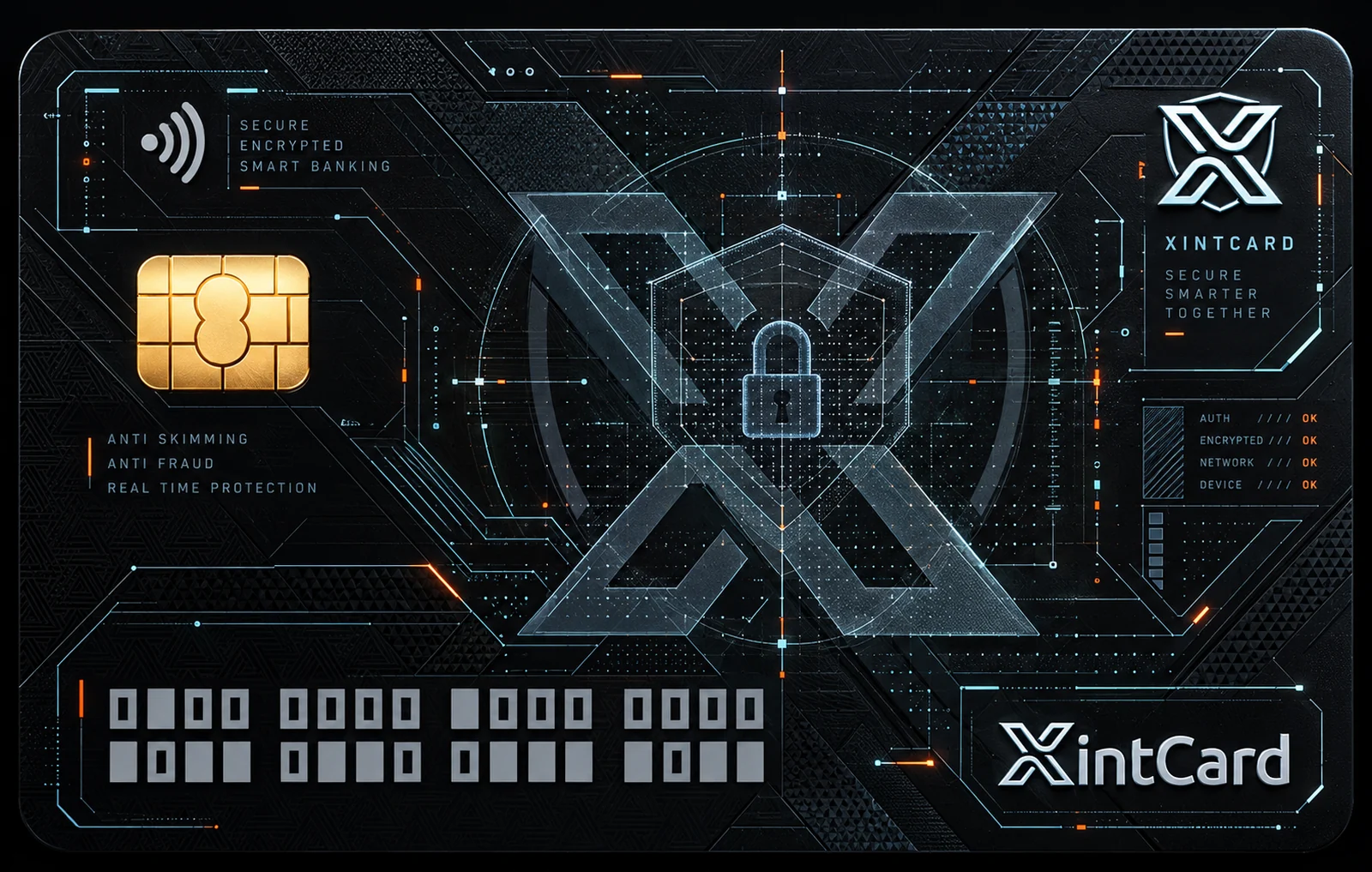
PROJECT XC / SECURE SMART DEBIT CARD
Every year, criminals take tens of billions of dollars from cardholders. They copy cards with hidden skimmers, steal card numbers online, and talk people into sending money with convincing phone calls and messages. A conventional debit card makes this easy. It carries the same number, the same expiry date and the same security code for years, and anyone who copies them can use them.
XintCard is a smart debit card designed to stop that. It keeps the holder's financial information encrypted inside a secure chip, never shows a merchant its real card number, and checks every payment in real time against the patterns of skimming, scams and account takeover. If someone does get hold of the card's details, they get nothing they can spend.
Our goal is simple: a card that is worthless to a fraudster, and a cardholder who never has to wonder whether their money is safe.
- TYPE
- Smart debit
- CARD DATA
- Encrypted
- CARD NUMBER
- Dynamic
- RISK CHECK
- Every payment
- PROTECTS
- In store · Online
- STATUS
- In development
Card fraud is a $33 billion a year industry
Card fraud is no longer petty crime. It is an organised, global business, and its victims are ordinary cardholders, the banks that issue their cards and the shops that accept them.
GLOBAL · 2024
$33.41B
lost to payment card fraud worldwide in a single year
NEXT 10 YEARS
$407.6B
in card fraud losses projected over the next decade
SCAMS · 12 MONTHS
$1.03T
taken from people worldwide by scammers, with only 4% of victims recovering everything
U.S. · 2025
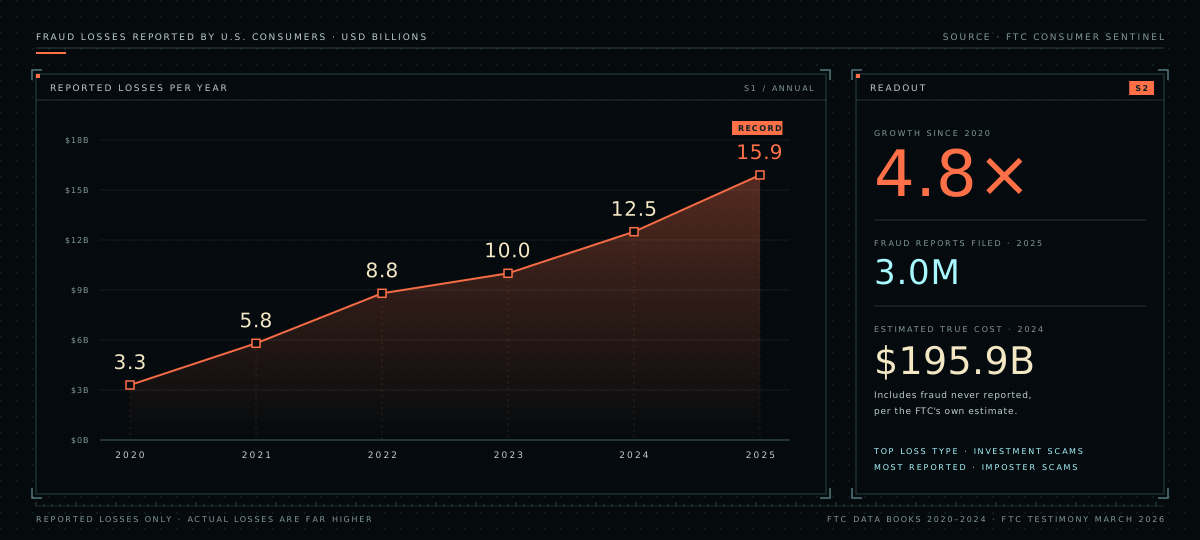
$15.9B
in fraud losses reported by U.S. consumers, a new record
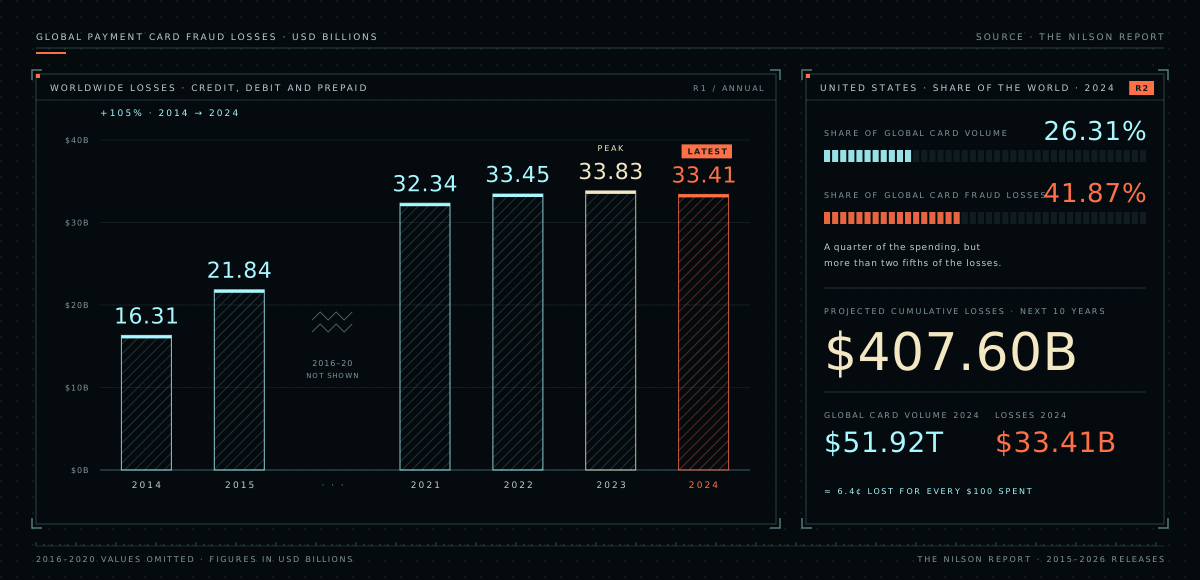
Losses have held at around $33 billion a year since 2022 while card spending kept growing, but that is no comfort to the people losing the money. Nearly 6.5 cents of every $100 spent on cards is still lost to fraud, and criminals are moving to the attacks that chip cards alone do not stop: online payments with stolen numbers, and scams that trick the cardholder into approving the payment themselves.
| Measure | Figure | Region and period | Source |
|---|---|---|---|
| Payment card fraud losses | $33.41 billion | Worldwide, 2024 | The Nilson Report |
| Losses per $100 of card spending | ≈ 6.4 cents | Worldwide, 2024 | The Nilson Report |
| Share of global card fraud losses | 41.87% (on 26.31% of card volume) | United States, 2024 | The Nilson Report |
| Money lost to scams | $1.03 trillion | Worldwide, 12 months to 2024 | Global Anti-Scam Alliance |
| Scams completed within 24 hours of first contact | Nearly half | Worldwide, 2024 | Global Anti-Scam Alliance |
| Fraud losses reported by consumers | $15.9 billion from 3 million reports | United States, 2025 | U.S. Federal Trade Commission |
| Identity theft reports of misuse of an existing credit card | 449,032 | United States, 2024 | U.S. Federal Trade Commission |
| Unauthorised fraud losses (cards, remote banking and cheques) | £722 million from 3.13 million cases | United Kingdom, 2024 | UK Finance |
| Remote purchase (online and phone) card fraud | Just under £400 million, up 11% | United Kingdom, 2024 | UK Finance |
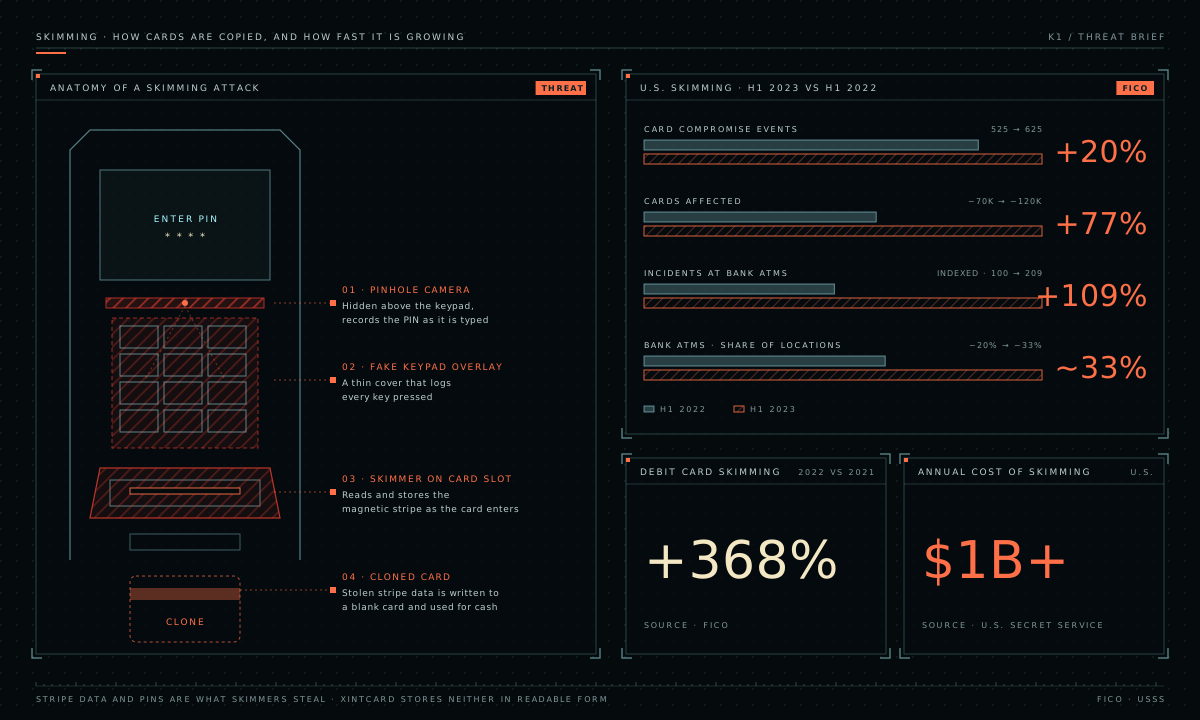
| Cost of card skimming | More than $1 billion a year | United States | U.S. Secret Service |
Skimmers copy cards in seconds, and they are spreading
A skimmer is a device hidden on an ATM, fuel pump or shop terminal. It reads the magnetic stripe as the card goes in, while a pinhole camera or fake keypad records the PIN. The criminal then writes the stolen data onto a blank card and empties the account. Skimming is growing fast, and criminals are now stealing far more cards from every device they plant.
CONVENTIONAL CARD
Everything a skimmer needs is on the card
A magnetic stripe stores the card number and expiry date in plain form. The number printed on the front never changes, and many terminals still fall back to the stripe when the chip fails. Once a skimmer has copied that data, the clone works until the cardholder notices and calls the bank.
XINTCARD
There is nothing readable to steal
XintCard carries no readable card data on a stripe. Its details stay sealed inside an encrypted chip, and every payment it makes is signed with a one-time code that cannot be replayed. A skimmer that copies XintCard gets meaningless data, and a cloned card is refused at the first attempt.
Four security layers that must all pass, every time
The status panel printed on the face of the card is a promise. Before XintCard authorises any payment, four independent checks must pass: the person, the data, the network and the device.
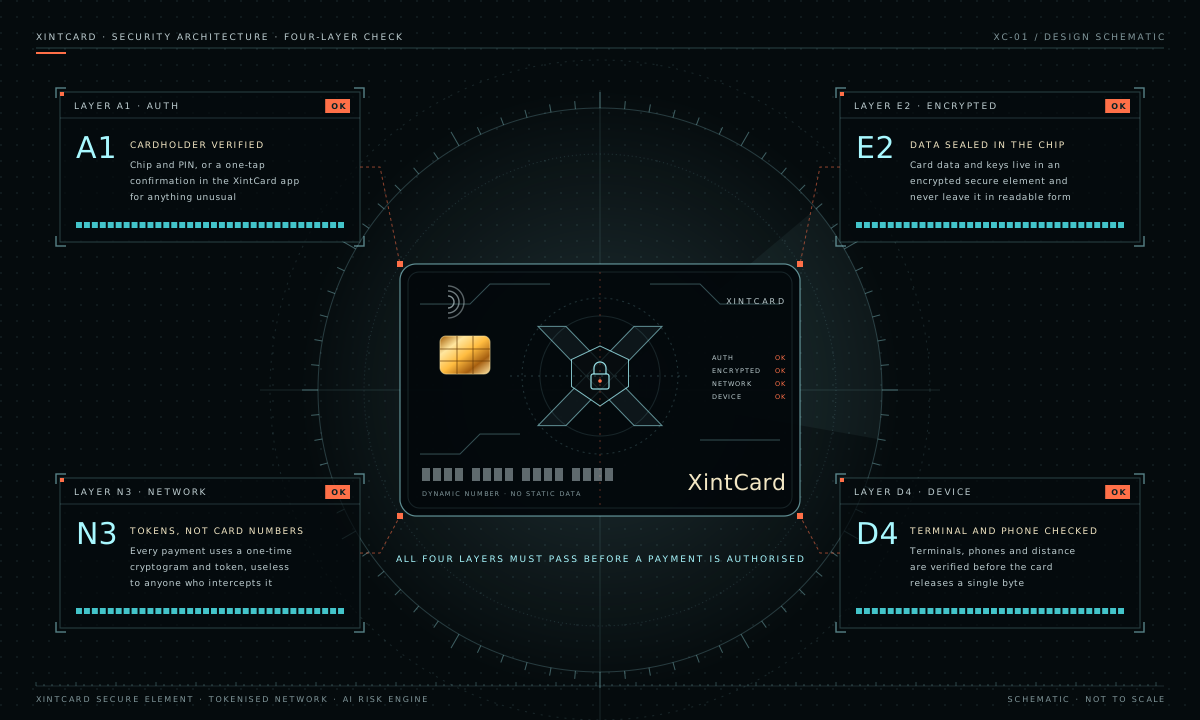
A1
Authentication
The cardholder is verified with chip and PIN, or with a one-tap confirmation in the XintCard app when a payment looks unusual.
E2
Encryption
Card data and keys live in a tamper-resistant secure element. They are encrypted at rest and never leave the chip in readable form.
N3
Network
Merchants receive a token and a one-time cryptogram instead of the real card number. Intercepted, they are useless.
D4
Device
The card checks the terminal and the phone it talks to, and measures response time to reject relay attacks on contactless payments.
- Dynamic card number. The number on the card face is masked. The details used for online shopping can be rotated at any time, or issued as single-use and per-merchant numbers from the app.
- Works everywhere cards work. Chip, contactless, online and mobile wallet payments all use the same protected flow.
- Privacy by design. Merchants never see the cardholder's real card number, and payment data is used to protect the cardholder, never sold.
Intelligence that knows the difference between you and a fraudster
Every XintCard payment passes through the Xint risk engine before it is approved. The engine compares the payment with the cardholder's own habits and with known fraud and scam patterns, and decides in a fraction of a second whether to approve it, ask the cardholder to confirm, or block it.
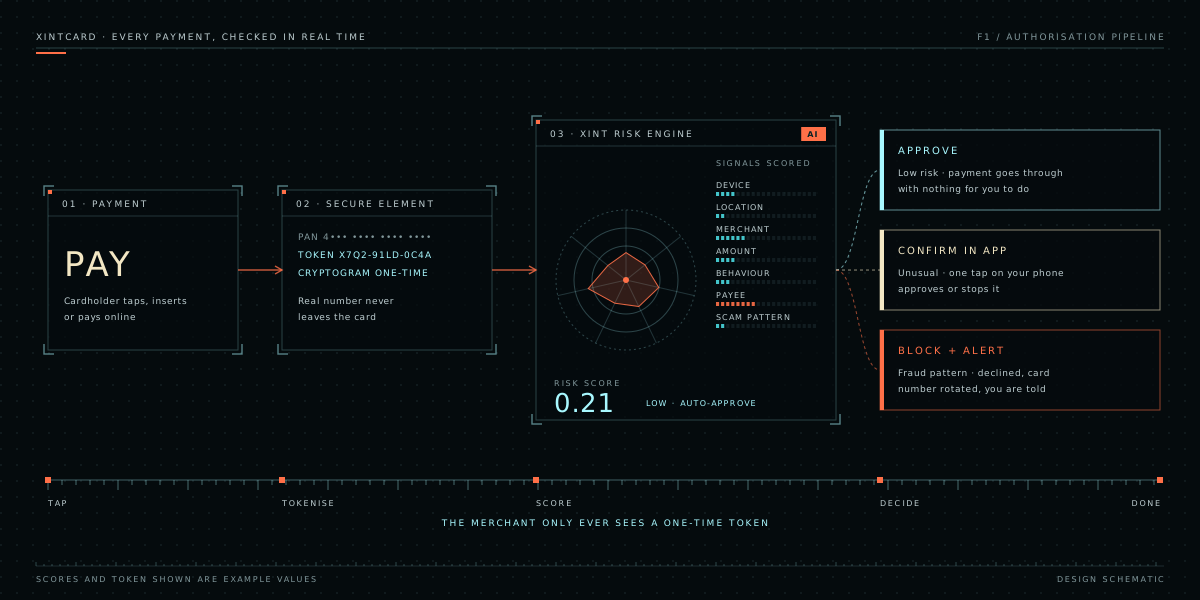
- The device and terminal the payment comes from
- Where the card is, and where the cardholder's phone is
- The merchant, its category and its fraud history
- The amount, compared with the cardholder's usual spending
- Behaviour: time of day, speed of purchases, new payees
- Known skimming locations and compromised merchants
- Scam patterns: urgency, first-time large transfers, cash-out routes
- Approve: everyday payments go through with nothing for the cardholder to do
- Confirm in app: an unusual payment waits for one tap on the cardholder's phone
- Block and alert: a fraud pattern is declined, the card details are rotated and the cardholder is told immediately
- Learn: every confirmation sharpens the model for that cardholder, so false alarms fall over time
Protection even when the cardholder is the one being fooled
The fastest-growing losses are scams, where a criminal persuades the victim to make the payment themselves. Chip cards cannot stop a payment the owner approves. XintCard can slow it down long enough for the owner to see the trap.
- STEP 01
Contact
A caller claims to be the bank, the police or a delivery firm, and says the money is at risk.
- STEP 02
Pressure
The victim is told to act now and to keep the call secret.
- STEP 03
Payment
A large payment to a new payee, gift cards or crypto is attempted.
- STEP 04
Detect
The Xint risk engine matches the payment to known scam patterns.
- STEP 05
Pause
The payment is held and the cardholder sees a clear scam warning in the app.
- STEP 06
Verify
A trusted contact can be asked to confirm, and the real bank is one tap away.
- STEP 07
Protect
The money stays put, the payee is flagged and other cardholders are warned.
Scammers win by rushing their victims. XintCard wins by giving them back the minute they need to think.
How XintCard answers every common form of card fraud
| Fraud type | How it works | How XintCard stops it |
|---|---|---|
| Skimming | A hidden reader copies the magnetic stripe at an ATM, pump or terminal | No readable stripe data; a cloned card fails the chip's one-time cryptogram |
| Shimming | A thin insert inside the card slot reads data from the chip | Chip data is encrypted and every cryptogram is single-use, so captured data cannot be replayed |
| Online card-not-present fraud | Stolen card numbers are used to shop online | Merchants only receive tokens; single-use and per-merchant numbers expire after use |
| Data breaches | Card numbers are stolen in bulk from a merchant's systems | The stolen data is a token tied to one merchant, and the card details can be rotated instantly |
| Phishing and fake websites | The cardholder is tricked into typing card details into a fake page | Online payments are confirmed in the app, which shows the real merchant name |
| Scam calls and messages | A criminal persuades the cardholder to send money | Scam-pattern detection holds the payment and warns the cardholder before money moves |
| Contactless relay | A criminal relays a card's signal from a pocket to a distant terminal | Response-time checks reject payments relayed over a distance |
| Lost or stolen card | A criminal uses a card that has been lost or taken | PIN or app confirmation, instant freeze from the app and location checks |
| Account takeover | A criminal changes the account's phone or email and takes control | Device binding and a waiting period before a new device can approve payments |
Peace of mind, built into the card
01
Nothing worth stealing
Copied, skimmed or leaked, XintCard's details cannot be used to make a payment.
02
Encrypted financial data
Card and account information is encrypted inside the chip and in transit, and is never stored or shared in readable form.
03
Real-time alerts
The cardholder is told about every payment as it happens, and about anything suspicious before it goes through.
04
Full control in the app
Freeze and unfreeze the card, set limits, block categories or countries, and create single-use numbers in seconds.
05
A guard against scams
Suspicious transfers are paused with a clear warning, giving the cardholder time to spot the trick.
06
No change in habits
Tap, insert or pay online as usual. The protection works in the background and only asks for attention when it matters.
| Feature | Conventional debit card | XintCard |
|---|---|---|
| Card number | Printed and fixed for years | Masked, rotatable, single-use and per-merchant options |
| Magnetic stripe data | Readable by any skimmer | No readable card data |
| What a merchant stores | The real card number | A token that is useless elsewhere |
| Fraud checks | Rules, often after the payment | AI risk scoring on every payment, before approval |
| Scam protection | None for payments the owner approves | Scam-pattern holds and in-app warnings |
| If the details leak | Wait for a replacement card | Rotate the details instantly in the app |
Built for cardholders, banks and merchants alike
Who benefits
- Cardholders, who keep their money and their peace of mind
- Banks and credit unions, who cut fraud write-offs, card reissue costs and support calls
- Merchants, who face fewer chargebacks and hold no card numbers worth stealing
- Older and vulnerable customers, who are the main targets of scams
How a launch works
- Pilot with an issuing bank or credit union
- Integration with the bank's card processor and payment networks
- Risk engine trained on the issuer's fraud history
- Card and app rollout to a pilot group of cardholders
- Measured fraud reduction, then wider rollout
- The Nilson Report: worldwide card fraud losses, the U.S. share, and the ten-year projection (2015 to 2026 releases).
- U.S. Federal Trade Commission: Consumer Sentinel Data Books 2020 to 2024 and congressional testimony, March 2026.
- Global Anti-Scam Alliance and Feedzai: Global State of Scams Report 2024.
- UK Finance: Annual Fraud Report 2025.
- FICO: U.S. card skimming data, 2022 and first half of 2023.
- U.S. Secret Service: annual cost of card skimming.
PARTNER WITH US ON A PILOT PROGRAMME